

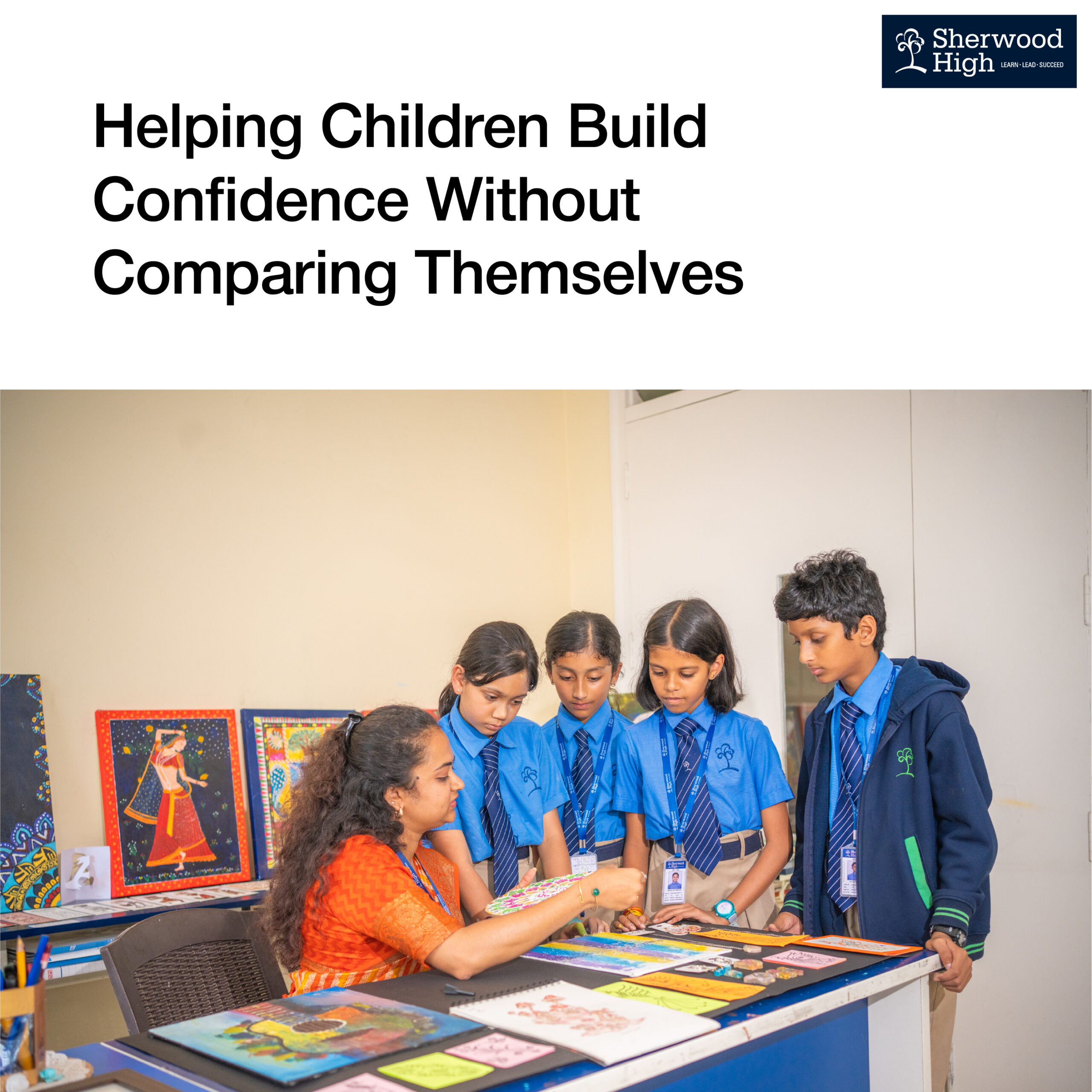
Helping Children Build Confidence Without Comparing Themselves
Children notice differences early.
Who finishes first.
Who scores higher.
Who speaks more confidently.
Who is better at sport, music, art or academics.
Comparison can sometimes help children understand where they stand, but when it becomes constant, it can slowly affect how they see themselves. Confidence begins to weaken when a child starts believing that being “good enough” depends on being better than someone else.
Helping children build healthy confidence means shifting the focus from comparison to progress.
Every Child Develops Differently
Children do not grow at the same pace.
One child may be confident in the classroom but hesitant on stage. Another may struggle with academics while showing remarkable creativity or empathy. A strength in one area does not make another child’s ability less valuable.
When adults recognise these differences without ranking them, children learn that growth can look different for everyone.
The goal is not to remove challenges. It is to help children understand that their journey does not need to look exactly like someone else’s.
Focus on Progress, Not Position
Instead of asking, “Who did better?” it can be more helpful to ask:
“What did you improve this time?”
“What felt easier than before?”
“What did you learn from this?”
These questions encourage children to notice their own progress.
A child who sees improvement in relation to their past effort is more likely to develop confidence that feels stable and personal, rather than dependent on outperforming others.
Praise Effort with Purpose
Encouragement matters, but the way we offer it matters too.
Rather than simply saying, “You are so smart,” we can notice the process behind the result.
“You kept trying even when it was difficult.”
“You found another way to solve the problem.”
“You prepared carefully for this.”
This helps children understand that effort, patience, strategy and persistence are qualities they can continue to build.
Confidence becomes stronger when children know what they did to earn progress.
Help Children Recognise Their Own Strengths
Children often notice what others do well before recognising what they themselves bring to the table.
Parents and educators can help by drawing attention to different kinds of strengths.
Being thoughtful is a strength.
Listening well is a strength.
Trying again is a strength.
Being curious is a strength.
Helping someone is a strength.
When children begin to see value beyond marks, medals or visible achievements, their idea of success becomes broader and healthier.
Be Careful with Everyday Comparisons
Even casual comments can stay with children.
“Your friend finished already.”
“Your sibling never struggled with this.”
“Look how confidently they speak.”
These statements may be intended as motivation, but they can make children feel that someone else has become the standard they must match.
A better approach is to keep the conversation centred on the child in front of us.
“What can help you improve?”
“What would you like to get better at?”
“What do you feel proud of today?”
This keeps growth personal.
Teach Children That Confidence Can Be Quiet
Confidence does not always look bold.
It can be raising a hand after being unsure.
It can be trying again after making a mistake.
It can be asking for help.
It can be saying, “I don’t know yet.”
Children benefit from understanding that confidence is not about always being the best, the loudest or the fastest.
Sometimes, confidence is simply trusting yourself enough to keep going.
Create Space for Healthy Challenge
Protecting children from comparison does not mean protecting them from challenge.
Challenges help children discover what they are capable of.
The difference is in how those challenges are framed.
When the focus is on learning, effort and improvement, children are more likely to see difficulty as something they can work through rather than proof that someone else is better.
This helps build resilience alongside confidence.
Confidence Grows from Within
The strongest confidence is not built by constantly telling children they are the best.
It grows when they learn to recognise their own effort, understand their strengths, accept areas they are still developing and keep moving forward without measuring every step against someone else.
When children learn to ask, “Am I growing?” instead of “Am I better?”, confidence becomes less fragile.
And that is a lesson that can stay with them far beyond the classroom.