

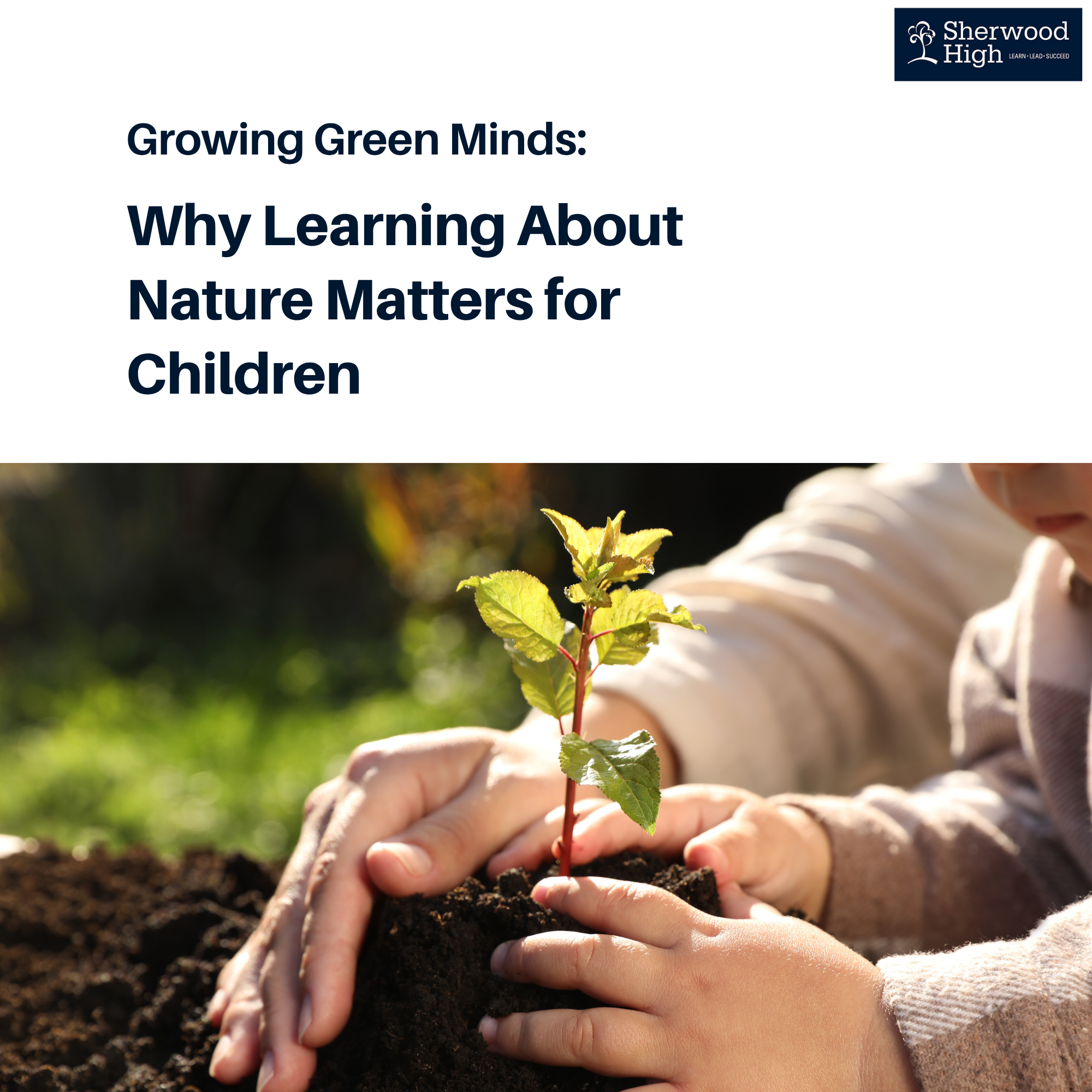
Growing Green Minds: Why Learning About Nature Matters for Children
In a world that is becoming increasingly fast-paced and technology-driven, children often find themselves more connected to screens than to the natural world around them. Yet, some of the most meaningful learning experiences do not come from textbooks or devices, but from the simple act of observing a leaf, listening to birdsong, or feeling the earth beneath their feet.
Learning about the environment and nature is not just an addition to education – it is an essential part of a child’s development. It nurtures curiosity, builds awareness, and helps children form a deeper connection with the world they live in. When children understand nature, they begin to value it. And when they value it, they are more likely to protect it.
At Sherwood High, we believe that environmental education for children plays a vital role in shaping thoughtful, responsible, and aware individuals.
Awakening Curiosity Through Nature
Children are naturally curious. They ask questions, observe patterns, and explore their surroundings with wonder. Nature provides the perfect environment for this curiosity to flourish.
A walk in the park can turn into a lesson on different types of plants. Watching ants carry food can spark questions about teamwork and survival. Even noticing changes in the weather can lead to discussions about seasons and climate.
Unlike structured classroom learning, nature offers open-ended exploration. There are no fixed answers – only discoveries waiting to be made. This kind of learning encourages children to think independently, ask meaningful questions, and develop a genuine love for exploration.
Building Awareness and Responsibility
Understanding the environment at an early age helps children become more aware of their surroundings and their role within it. When children learn about concepts like conservation, pollution, and sustainability, they begin to see how their actions impact the world.
Simple habits such as turning off lights, saving water, or not littering become meaningful when children understand why they matter. These small actions lay the foundation for responsible behaviour and environmental consciousness.
Sustainability education for children is not about overwhelming them with global issues, but about helping them feel connected and capable of making a difference – even in small ways.
Supporting Emotional and Mental Well-being
Spending time in nature has a calming and grounding effect on children. It provides a break from structured routines and allows them to relax, reflect, and recharge.
Outdoor learning environments reduce stress, improve focus, and support emotional well-being. Whether it’s playing in an open field, tending to a garden, or simply sitting under a tree, these moments help children feel more balanced and present.
Nature also teaches patience and mindfulness. Watching a plant grow or waiting for a butterfly to land requires stillness – something that is increasingly rare in today’s fast-moving world.
Encouraging Creativity and Imagination
Nature is one of the greatest sources of inspiration for creativity. A child might turn fallen leaves into art, imagine stories about animals, or create games using natural elements around them.
Unlike structured toys or predefined activities, nature allows for endless possibilities. A stick can become a wand, a tool, or part of a story. A patch of mud can turn into a creative experiment.
This kind of unstructured play supports imaginative thinking, problem-solving, and innovation – skills that are essential for future learning and development.
Developing Life Skills Through Experience
Learning about nature also helps children develop important life skills. Activities such as gardening, observing ecosystems, or caring for plants teach responsibility, patience, and consistency.
Children learn that actions have consequences – plants need water to grow, litter harms animals, and resources must be used wisely. These lessons are not taught through instruction alone but through experience.
Experiential learning in nature allows children to connect theory with reality, making their understanding deeper and more meaningful.
Fostering Respect for the World Around Us
Perhaps the most important outcome of nature learning is the sense of respect it cultivates. When children spend time outdoors and understand how ecosystems function, they begin to appreciate the delicate balance of the natural world.
They learn to respect living things – plants, animals, and even the environment itself. This respect extends beyond nature and influences how they treat people, communities, and shared spaces.
In this way, environmental education becomes a pathway to building compassionate and responsible individuals.
A Foundation for a Sustainable Future
The challenges of the future – climate change, resource management, and environmental preservation – require individuals who are informed, aware, and proactive. By introducing children to nature and sustainability early on, we prepare them to face these challenges with understanding and confidence.
Children who grow up connected to nature are more likely to carry forward values of care, responsibility, and mindful living. They become individuals who not only understand the world but also contribute positively to it.
Learning Beyond the Classroom
At Sherwood High, we believe that some of the most powerful lessons happen beyond classroom walls. Through outdoor activities, nature-based learning, and experiential exploration, children are encouraged to engage with their environment in meaningful ways.
Because when children learn about nature, they are not just learning about plants, animals, or ecosystems – they are learning about connection, responsibility, and the importance of preserving the world they call home.
And in nurturing that connection early, we are not just educating children – we are shaping the caretakers of tomorrow.